Human First: Why Real Connection Matters in an AI World
As AI makes creation faster and easier, human judgment, authenticity and real experience are becoming more valuable than ever.
By Josh Lewis | September 2, 2026

Photography by Josh Lewis | Landscape Design by David Thorn (DT Design)
Human First: Why Real Connection Is Becoming More Valuable in an AI World
There has never been an easier time to create something at the drop of a hat.
We can write faster, edit photographs faster, build presentations faster, develop ideas faster and turn a rough thought into something polished in a fraction of the time it once took. I use many of these tools myself, and I think they can be incredibly useful. I’ve sat around the table at friends’ dinner parties having long conversations about AI, its role in marketing, and where we all think this is heading. Those conversations usually come back to the same question for me: as the technology gets better, what becomes more valuable about the human being behind the work?But the more I work with AI, the more convinced I become that the future of good creative work will not be defined by how much technology we can use. It will be defined by knowing when technology helps the idea, and when the work needs the judgment, perspective and imperfection that only a person can bring.
That distinction feels increasingly important.
As generated images, automated writing and highly polished content become more common, people are also becoming more familiar with what that content feels like. Something can be technically impressive and still feel strangely empty. A photograph can be flawless and somehow less believable. A paragraph can be perfectly written and still sound like nobody in particular wrote it.
We have gained an extraordinary ability to create.
The challenge now is making sure we do not remove the person from the creation. I have already seen that tension play out in my own work. Before I came on board, one client had received social media comments calling some of their AI generated creative “AI slop,” with people even saying it made them less interested in attending their events. What struck me was not simply the criticism of AI. It was what people seemed to be asking for instead. They wanted to feel that somebody real was behind what they were seeing.
When Better Does Not Feel Better
I have experienced this firsthand with photography.
There are tools now that can remove noise, sharpen details, extend backgrounds, correct lighting and supposedly improve an image almost automatically. I have experimented with many of them because I am genuinely interested in what the technology can do.
Sometimes the result is remarkable.
Other times, I have watched a perfectly good photograph slowly become worse.
The image may technically become cleaner. Details become sharper. Imperfections disappear. But somewhere in the process, texture begins to look unnatural or a face loses something familiar. The photograph stops looking like a moment that actually happened and begins looking like someone's idea of what that moment should have looked like.
There is no automatic setting that can tell me when that line has been crossed.
I have to look at the image and decide.
That decision has made me think differently about the word improvement. Just because technology can make something smoother, cleaner or more dramatic does not necessarily mean it has made it better.
Sometimes the imperfection is what makes the image believable.
I think the same thing is happening in branding, advertising and social media. We have spent years working toward polish, consistency and perfection. Now we have tools capable of producing all three almost instantly.
The problem is that perfection can become anonymous. And the human touch is often imperfect.
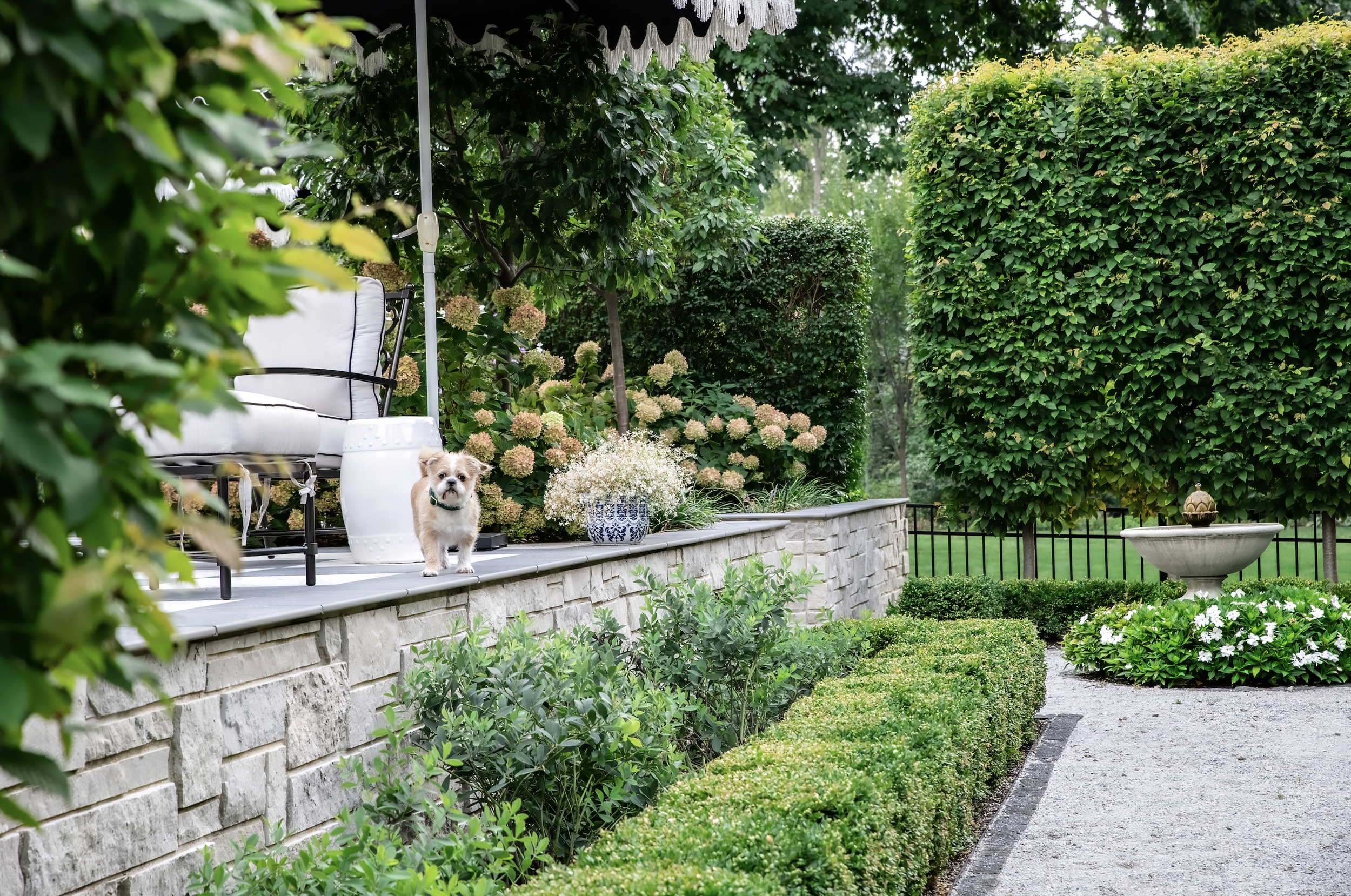
Photography by Josh Lewis | Landscape Design by David Thorn (DT Design)
The Value of Something That Actually Happened
Recently, I photographed a private garden.
It was the kind of space that revealed itself gradually. There were hedges, fountains, pathways, architectural details, outdoor rooms and flowers tucked into places you might miss if you moved too quickly.
I came away with a large number of photographs, but the images I found myself returning to were not necessarily the most obvious ones.
One photograph looks through greenery toward a table. Another catches flowers beneath a striped awning. A pathway disappears through a gate. Light falls across a section of the garden differently for a few minutes and then changes.
There was also a photograph of the front of the house that would have immediately explained the property and given the viewer a clear sense of place. It was a good photograph.
But I had told the homeowners I would not publicly show the front of their home, so I removed it from consideration.
What surprised me was that the collection became more interesting without it.
Instead of explaining the entire place immediately, the photographs began to feel like an invitation to discover it. You enter through the garden instead of looking at the property from a distance.
That decision had nothing to do with what my camera could do or what editing software could produce. It came from context, trust and judgment.
It also reminded me why real photography is beginning to mean even more to me.
AI could generate an extraordinary garden. It could probably create one more dramatic than the garden I photographed. It could produce perfect flowers, perfect light and perfect symmetry.
But it was never standing there.
Someone actually planted those flowers. Someone designed that path. The light actually looked that way. I happened to be there at that moment with a camera.
That matters.
Authenticity Is Not the Same as Imperfection
When people talk about authenticity in marketing, the word can become so overused that it loses meaning.
I do not think authenticity means making things intentionally rough or unpolished. It does not mean abandoning professional photography, good design or thoughtful writing.
To me, it means there is evidence that somebody made a choice.
Someone decided why the photograph should be taken from that angle.
Someone decided which sentence did not sound right.
Someone removed the extra graphic.
Someone chose a typeface because of what it communicated, not simply because it was popular.
Someone noticed when the automated result looked wrong.
That person does not have to reject technology. They simply have to remain responsible for the outcome.
I notice this constantly in my own writing.
I can use AI to generate dozens of versions of a headline, an introduction or a caption. Some are technically excellent. Some are clever. Some would probably perform well.
But they are not automatically mine.
I still have to decide what sounds like something I would actually say. I change words. I remove phrases. I add details. Sometimes I deliberately make a sentence simpler because the more polished version does not sound human to me, or does not sound like me at all.
The tool can help me get somewhere faster.
It cannot decide who I am when I arrive.
People Remember Evidence of Care
When I think about brands, places and experiences that stay with me, the details I remember are rarely the most efficient ones.
I remember the restaurant where somebody clearly cared about how the table looked before anyone sat down. (And I notice those details when I do sit down, don’t you?)
I remember a historic building where the old details were preserved instead of replaced because someone understood that those imperfections carried part of the story.
I notice when a store has an unusual sign, when a menu has restraint, when flowers have been arranged thoughtfully or when the music in a room feels completely right for the space.
None of those decisions are revolutionary.
They simply create evidence that somebody cared.
That is one of the things I worry about losing when everything becomes optimized.
Technology is extremely good at solving for efficiency. Humans are often moved by things that are not especially efficient.
A handwritten note takes longer than an automated email.
A photographer waiting for the light to change is less efficient than generating the scene.
Writing something from personal experience takes longer than producing fifty variations instantly.
But those things can create a different kind of value.
They create connection.
Human First Does Not Mean Human Only
I do not want to return to a world where every creative task takes twice as long simply because that was once the process.
I like having better tools.
I like being able to explore an idea quickly. I like using technology to organize thoughts, solve problems, research possibilities and remove repetitive work. I like that a single person can now do things that once required an entire team.
AI is going to remain part of my work.
But I am becoming more interested in using it behind the work rather than allowing it to become the identity of the work.
Help me find another direction.
Help me understand something faster and see possibilities I had not considered, then let me decide.
That final step is where I think much of the value now lives.
As creation becomes easier, judgment becomes more important.
An individual point of view becomes easier to recognize.
And as audiences become increasingly aware that almost anything can be created artificially, the fact that something actually happened may carry more weight.
A real person stood there, noticed something, made a decision and cared enough to change it.
That is not an argument against AI.
It is an argument for remembering what the technology is supposed to support.
People do not build relationships with efficiency. They build relationships with stories, personalities, memories, places, ideas and experiences.
As we become more technologically advanced and spend more of our lives looking through screens, I sometimes wonder if we are also becoming hungry for things that make us feel more. A real place. A real conversation. A photograph of something that actually happened. A story told by somebody who lived it.
We want to feel something.
We want to recognize a point of view.
And I think, more and more, we want to know that somewhere behind what we are seeing, someone was paying attention.
That is why I believe the strongest response to an increasingly automated creative world will not be louder technology.
It will be better human judgment.
More individual voices.
More specific stories.
More thoughtful choices and willingness to leave something alone when fixing it would remove the very thing that made it feel real.
The technology will keep improving, and I plan to keep using it.
But I also want my work to keep feeling like mine.
Because when almost anything can be generated, the things that were actually seen, experienced, considered and chosen by another person may become more valuable than ever.
Maybe that is the opportunity in all of this. Not to become less technological, but to become more intentional about protecting the parts of our work, our brands and our experiences that make people feel something in the first place.
About Josh Lewis:
Josh Lewis is a brand strategist and creative director helping consumer brands grow through branding, retail experiences, merchandising, and customer experience.